 [Home] [Physics]
[Overview] [Myths]
[Fast Physics] [Underwater Relativity]
[What is Matter?] [Classical Theory]
[Home] [Physics]
[Overview] [Myths]
[Fast Physics] [Underwater Relativity]
[What is Matter?] [Classical Theory]
|
|
|
Science is the belief in the ignorance of experts.
Richard Feynman [The Physics Teacher, 7 September, 1969, 313-320] Resources (in order of difficulty): What would a classical universe be like? A brief summary is given here.
Rationale for studying aether models of the universe.
Some common misconceptions about modern physics.
Brief explanations of physics concepts.
2016
Clark College Faculty Speaker Series lecture "Illuminating
the Theory of Relativity"
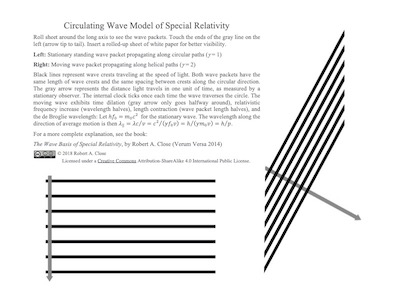
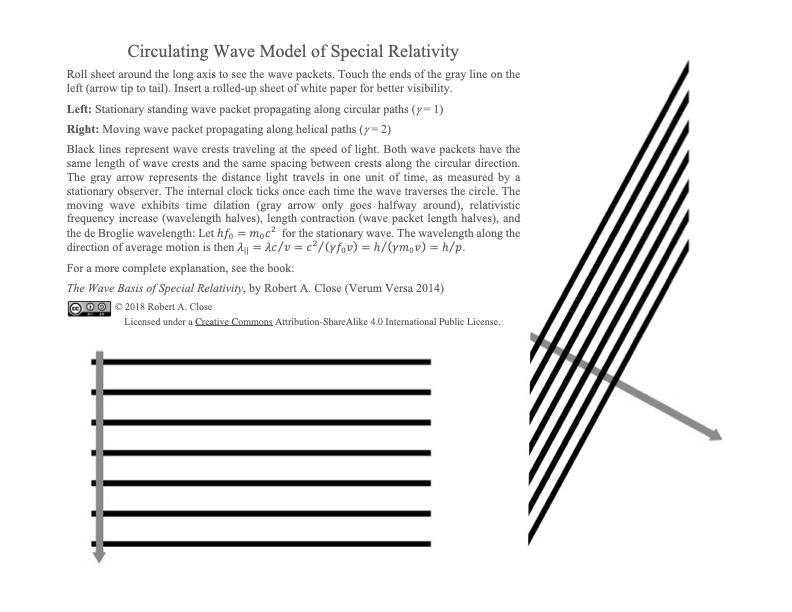
Circulating Wave Model of Special Relativity [jpg] Print this sheet on transparency paper and roll it into a cylinder to demonstrate relativistic frequency shift, time dilation, length contraction, and de Broglie wavelength for a particle-like wave packet. (See the video No-Nonsense Physics: Wave-Particle Duality)
Matter Waves and Relativity [pdf] A hands-on high school or college-level activity for learning about relativistic time dilation and length contraction.
Underwater Relativity [swf] Animations demonstrate how the wave nature of matter implies the laws of Special Relativity. (For an overview, watch the video No-Nonsense Physics: Special Relativity)
What is Matter? [pdf] This is a slide presentation explaining relativity and other wave properties of matter at a high school level.
A Time Traveler's History of Physics [pdf] Presentation at the APS April Meeting, Anaheim, CA on April 30, 2011.
The Other Meaning of Relativity [pdf] Einstein’s special theory of relativity postulates that the speed of light is a constant for all inertial observers. This postulate can be used to derive the Lorenz transformations relating length and time measurements by different observers. In this paper it is shown that the Lorentz transformations can be obtained for any type of wave simply by defining distance to be proportional to wave propagation time. The special nature of light is that length and time measured by light propagation correspond exactly with length and time measured by material rulers and clocks. This suggests that material objects consist of waves propagating at the speed of light. Taking this as an alternative postulate for special relativity implies constancy of the measured speed of light without any recourse to non-Euclidean geometry of physical space-time. This alternative postulate is consistent with de Broglie’s wave hypothesis, with the Dirac velocity operator of quantum mechanics, and with experimental observations of transformations between matter and light.
Exact Description of Rotational Waves in an Elastic Solid (Adv. Appl. Clifford Algebras 21:273-281, 2011) The dynamical behavior of an ideal elastic solid is arguably the most fundamental problem in theoretical physics, yet its mathematical description has eluded physicists – until now. Rotational (incompressible) waves in an elastic solid provide a physical interpretation of quantum mechanical operators and statistics.
Spin Angular Momentum and the Dirac Equation (EJTP 12, No. 33 (2015) 43–60) The usual definition of angular momentum, r×p, is clearly unphysical because it depends on the choice of origin for definition of the radius vector r. A better physical description defines spin angular momentum density as the field whose curl is equal to twice the momentum density: p=(1/2)∇×S This definition yields the usual classical results for total angular momentum and kinetic energy. When applied to elastic waves, it also yields the quantum mechanical operators for orbital and spin angular momentum.
The Classical Wave Theory of Matter (2011 .pdf format) This is a draft undergraduate level book which uses classical wave theory to explain many properties of matter including Special Relativity, gravity, spin 1/2 'particles', and other wave characteristics of matter.
Torsion Waves in Three Dimensions: Quantum Mechanics with a Twist (Foundations of Physics Letters, Vol 15, No. 1, February 2002) . Available from SpringerLink. A classical physics derivation of the Dirac equation. See also Chapter 2 of The Classical Theory of Matter Waves.
Why There Are No Right-Handed Neutrinos (Or Other 'Mirror Matter') (.pdf) Presentation at APS April Meeting, Denver, Colorado, May 2-4, 2009
The Mirror Symmetry of Matter and Antimatter (Adv. Appl. Clifford Algebras 21:283-295, 2011) When viewed in a mirror, all known physical processes appear to proceed as if matter and anti-matter were exchanged. The simplest explanation for this observation is that spatial reflection (or parity operation) exchanges matter and anti-matter. Yet the prevailing opinion is that certain processes such as weak interactions have no physical equivalent to their mirror images. We resolve this dilemma by showing that the conventional Dirac parity operator is incorrect. The conventional derivation relies on a speculative relativistic argument which is unrelated to Lorentz invariance. We derive a new spatial reflection operator by requiring that for any orthogonal coordinate basis, all three axes must have the same parity. The new spatial reflection operator is is found to induce an exchange of matter and anti-matter, consistent with all experimental evidence. A new time reversal operator is also derived.
Parity, Time Reversal, and Relativity (.ppt presentation at APS Northwest Meeting, Portland, OR, May 15-17, 2007)
The Parity Illusion (.pdf presentation at APS California Meeting, Los Angeles, CA, October 17-18, 2008)
Links: Free and open inquiry is the basis of progress. Please support freedom of expression, human rights, and education for all. http://www.amnesty.org Amnesty International http://hrw.org Human Rights Watch http://www.oxfam.org Oxfam International http://www.redcross.int International Red Cross and Red Crescent Movement http://www.unicef.org United Nations Children’s Fund Physics Links: http://www.aps.org American Physical Society http://www.iop.org Institute of Physics http://home.online.no/ ~ukarlsen B. U. Karlsen "The Great Puzzle," 2003 updated from "Sketch of a Matter Model in an Elastic Universe," 1998. This is a different attempt at a classical description of matter based on the elastic solid model. This is a good summary of doubts about modern physics and possible alternatives. http://math.ucr.edu/home/baez/relativity.html
Relativity
on the World Wide Web http://www.skeptic.com The Skeptics Society is a scientific and educational organization of scholars, scientists, historians, magicians, professors and teachers, and anyone curious about controversial ideas, extraordinary claims, revolutionary ideas, and the promotion of science. About the Author: Dr. Robert A. Close holds a BS in physics from the Massachusetts Institute of Technology and a PhD in physics from the University of California at Berkeley. |
Created: February 27, 2006; Last updated:
Copyright © 2006-